Showing posts with label Jesus. Show all posts

Thursday, July 30, 2009

Catholics and Crucifixes

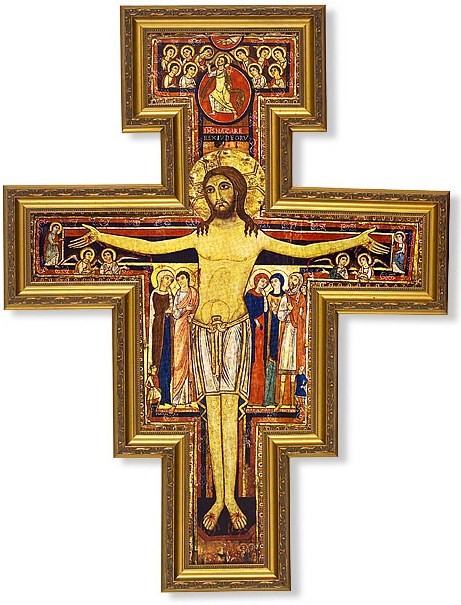
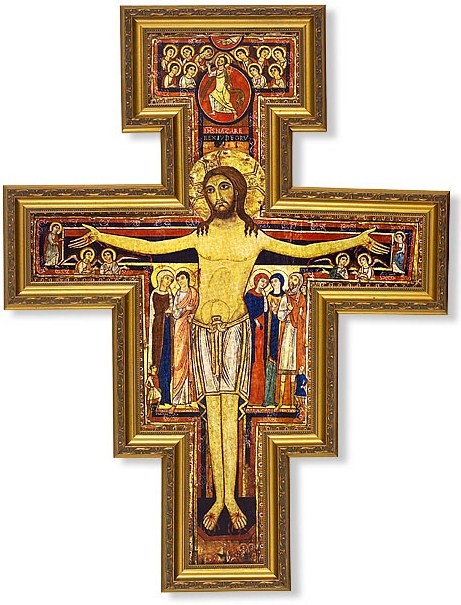
Crucifixes are crosses which have the corpus (body) of Jesus on them to represent the historical crucifixion of Our Lord. The cross alone, with no body, has been a symbol of Christianity since antiquity. The very instrument of capital punishment and horrible torture by the pagan Roman Empire became a symbol of the loving and forgiving crucified Savior.


Catholics are not the only Christians to use the crucifix in church for public worship or in their homes. Eastern Orthodox, Anglican (Episcopalian) and Lutheran Christians also use the crucifix, while most Reformed Protestant Christians will only have a cross and never with a corpus.


The main goal of the crucifix is not to shock or frighten believers, but to remind them of the ultimate price paid for their salvation. Redemption was expensive. Jesus sacrificed His very life and He endured a painful and horrible death just so we could go to heaven. The crucifix brings home the reality that sin caused us to be lost and ony the death of the Savior could save us. Celebrating Christian worship on Sunday (rather than on the Sabbath, Saturday) and calling it the day of the Lord is how Christians honor the Resurrection.

Sunday, January 11, 2009

The Feast of the Baptism of the Lord

"Let us do honor to Christ's baptism and celebrate this feast in holiness. Be cleansed entirely and continue to be cleansed. Nothing gives such pleasure to God as the conversion and salvation of men, for whom His every word and every revelation exists. He wants you to become a living force for all mankind, lights shining in the world. You are to be radiant lights as you stand beside Christ, the great light, bathed in the glory of Him who is the light of heaven. You are to enjoy more and more the pure and dazzling light of the Trinity, as now you have received-though not in its fullness-a ray of its splendor, proceeding from the one God, in Christ Jesus our Lord."
Saint Gregory Nazianzus, Bishop (330-389AD), Oratio 39, "Sancta Lumina," 14-16,20.

Tuesday, January 6, 2009

Jesus Made Me Do It


Why is it that if you were to mention the name of Buddah, Mohammed or Confucius you would be viewed as someone who has an open mind, is well read and informed, but, if you mention the name of Jesus, the conversation gets uncomfortable? I think it is Jesus' fault. After all, Buddah, Mohammed or Confucius were great moral teachers. They pointed their followers to something greater than themselves. They would say, "don't look to me, look to my teaching." Jesus on the other hand doesn't point to anything greater than himself. He doesn't say, "follow my teaching" he says, "follow me!" That is a pretty bold statement.

All other religious leaders have used a sort of third point of reference. The "meaning of life" can be spoken of in the third person. You can disregard the teaching without disregarding the teacher. That doesn't work with Jesus because he is his teaching. He isn't just the messenger, he is the message. The two are inseparable. Jesus doesn't tell us that he will show us the way, the truth and the life. He says, "I AM the way, the truth and the life." You can't reject Jesus' way without rejecting Jesus.

Jesus requires a response; He provokes a response. For some it is a response of adoration and worship; for others it is a response of anger and hate. Why would one respond in anger? Because when we look Jesus, he shows us ourselves. (Remember in high school when the really pretty girl would walk in the room and all the other girls would tear her down behind her back? Imagine how they would talk about her if she were the smartest as well.) When we look at Jesus, we see our true selves; and we don't like what we see.

The good news is that Jesus has come to make all things new. He has come to establish a new humanity where we are free to be as God intended. Jesus came not only to free us from the consequence of sin; he came to free us from our sin. This comes at an expense. We have to be willing to give our entire selves. We have to be willing to give up our pride, fear, lusts-- our sins. But many times, we don't want to. We want to hold on to these things that are so "precious" to us and God will allow us to do so. It will change us not unlike the transformation Smeagol experienced when he held onto the ring.

Lord, change me...make me new!!!

Thursday, December 11, 2008

The Philosophy of Jesus

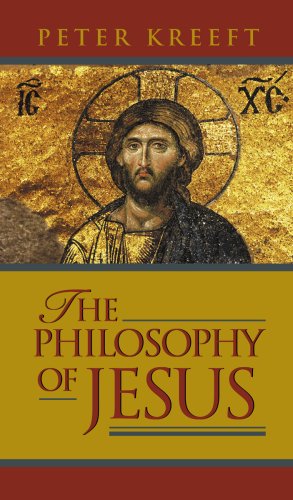
I have recently been introduced to Peter Kreeft. Dr. Kreeft is a philosophy professor at Boston College and a fantastic Catholic apologist. He has written a Catholic version of the C.S. Lewis classic, The Screwtape Letters (one of my all time favorites).

I just started reading The Philosophy of Jesus and was floored with the introduction. Kreeft begins by explaining the four basic questions of philosophy:

1. What is real? (metaphysics)
2. How can we know what is real? (epistemology)
3. Who are we? (philosophical anthropology)
4. What should we be? (ethics)


Kreeft then goes on the say that philosophers have argued about these four questions for most of the last two millennia. One philosopher spends his time arguing that the others are idiots...and he usually proves it. The Christian response to these four questions is what has my wheels turning. This is what Dr. Kreeft has to say:

"The Christian answer: because the only adequate and final answer to all four great philosophical questions is Christ. The most philosophical writer in the Bible, John, begins his Gospel by identifying Jesus with the Logos ("In the beginning was the Logos, and the Logos was with God and the Logos was God...and the Logos became flesh and dwelt among us.") What is the Logos? It is an incredibly rich Greek word. Here are some of its meanings: the Logos means the Word of God, the Revelation of God, the Speech of God, the Wisdom of God, the Mind of God, the Truth of God, the Reason of God, the Philosophy of God.

"Jesus is God's philosophy. "

What does this mean for us? How is Jesus the philosophy of God? I am having quite a time trying to wrap my mind around this one. If anyone has any thoughts on this, please leave them in the comment box.

Tuesday, March 11, 2008

The Blessed Sacrament

I've recently created a video entitled, 'The Blessed Sacrament,' and I just learned that I'm able to upload video's to my blogsite. Another cool feature on Blogger! Here's the video in case you don't feel like browsing through youtube or Godtube.com


Friday, February 29, 2008

Christ and His Mother

To know a little more about the relationship between Christ and his mother we have to fully understand who Christ is. It’s very important that we do not see Christ as something changeable or inferior. As Christians, we believe that Christ was not created because if he had been created, something (which created him) was superior, thus the Church has always taught us that Christ was uncreated –‘begotten, not made.’ We should all recognize that The Creator became a creature. As St. Augustine says, “He whom the world could not contain was contained in a mother’s womb.”

With all this said I would like to ask, ‘What would you do if you were able to choose your own mother, and how would you create her?’ Catholic Author F.J. Sheed couldn’t have explained it any better:
__________________________________________________________________

“. . . In seeing what the difference is, a good starting point is the simple fact that this son existed before his mother. So that he is the only Son who was in a position to choose who his mother should be; he could choose therefore what every son would choose if he could, the mother who would suit him best. Further, it goes with the very heart of sonship that a son wants to give his mother gifts; and Christ, being God, could give her all that she would want. To his giving power there was no limit. And what above all she wanted was union with God, the completest union possible to a human being of her will with God’s will, grace therefore in her soul.

He was her Son, and he gave it lavishly. She responded totally, so that she was sinless. It was her response to the grace of God that made her supreme in holiness – higher even that the highest angel, the Church tells us. We may pause for a moment to look at this truth. . .”

[1] Theology for Beginners. F. J. Sheed. Servant Books. Chapter 15, pg. 128.

Saturday, December 15, 2007

December 25 - "The Feast of Lights"

With Advent season at hand, I picked up a book recently released by Pope Benedict XVI entitled, “The Blessing of Christmas.” Throughout the book Pope Benedict helps us understand Christmas as the most profoundly human feast of faith, because it allows us to feel most deeply the humanity of God. I’ve provided the text below that may help some of us fully understand what Jesus accomplished in his birth.

Pope Benedict XVI on December 25th. . .

“From the very beginning, this was made clear by the date of this feast. In the Jewish calendar, December 25 was and remains the feast of Hanukkah, the feast of lights, which recalls how on this day in 165 B.C., Judas Maccabeus removed the altar of Zeus-which tradition called the ‘abomination of desolation in the holy place’ – from the Temple in Jerusalem. It was on the same date that the Syrian King Antiochus, who was worshipped as ‘Zeus’, had set up the pagan idol in the temple, designating December 25 as his own feast day. Now it became the date of the cleansing of the Temple, and day on which the glory of God, which had been trampled underfoot, was reestablished and God began to be honored anew in the proper manner. It was from this day on that Israel dated its own rebirth: as soon as it was once again able to serve God in the appropriate way, Israel itself was restored.

Since the week from December 25 to 31 was also the week before the New Year, this restoration took on an even deper significance. It portrayed the new beginning of creation, the new time of freedom from which men hoped. This is why, as early as around 100 B.C., the birth of the messianic child was expected on this date. During Jesus’ own lifetime, this feast was already celebrated as the feast of lights, in keeping with the prophet Isaiah’s words: “the people who walked in darkness have seen a great light” (Is 9:2)

In his infancy narrative, Luke unfolds a chronology with a profound symbolic meaning, dating it in such a way that the birth of Jesus occurs during the feast of Hanukkah, “on the night of lights”, which thus became the Christian feast of Christmas. We should also note that Bo Reicke, formerly professor of exegesis in Basel, has also pointed to the festal calendar that lies behind the chronological link made in the Gospel of Luke between the birth of John the Baptist and the birth of Jesus. This would mean that Luke himself assumes that Jesus was born on December 25, the day of which the feast of dedication of the Temple (introduced by Judas Maccabeus in 164 B.C.) was celebrated.

In his birth, Christ has truly done what Judas Maccabeus sought in vain to do. Christ has banished the pagan idols from the world. He has constructed the temple of his body. He has reestablished the glory of God.”

1) Pope Benedict XVI. The Blessing of Christmas. Ignatius. 2007

Wednesday, November 21, 2007

Temptation of Jesus: Part 2 of 4

As we continue our study on, The Temptation of Jesus (Edward Sri's study on the Gospel of Matthew, Mystery of the Kingdom), we are now going to take a closer look at His first temptation in the desert.

Israel's first test. The first of Israel's trials involved hunger. In the Book of Exodus we can all recall when Moses parted the Red Sea and led all the Israelites away from bondage and into the desert. The Israelites celebrated their new found freedom as they were no longer slaves of Pharaoh. However, they soon faced their first problem: Where would they find food in the desert? How were they going to eat? Their rejoicing quickly turned into panic. We might of expected Israel to trust in God to provide, instead we see the people turned against Moses, saying "You have brought us out into this wilderness to kill this whole assembly with hunger" (Ex 16:3). Israel's failure: Not trusting the Father.

Sri now looks at Jesus' first test. Similarly, we all know that Jesus also faced hunger in His first temptation with the devil. The devil wanted Jesus to use His power as the Son of God to break His forty days of fasting. You see, the Father sent the Spirit to lead Jesus into the desert to pray and fast for forty days, for Jesus to turn the stones into bread would be to exercise His messianic authority for His own self interest and thus depart from the Father's will. Now, remember Israel's failure of not trusting the Father, well Jesus does not waver from trusting the Father. In fact, He quotes Deuteronomy 8:3 (a passage that brings to mind the story of Israel's first test), saying "Man shall not live by bread alone" (Mt. 4:4). Jesus overcomes the first major fall of Israel in the desert.

[1] Exodus 16:3
[2] Deuteronomy 8:3
[3] Matthew 4:4
[4] Mystery of the Kingdom. Edward Sri

Thursday, November 8, 2007

The Temptation of Jesus (Part 1 of 4)

In the following post I will share a multi-part study on Jesus overcoming the three temptations of the devil (Mt 4:1-11). , taken from Edward Sri's study on the Gospel of Matthew entitled, Mystery of the Kingdom. By taking a closer look at how the three temptations of Jesus relate to the first three major trials of Israel in the Exodus, we’ll be able to identify that the failings of Israel are symbolically overcome by Jesus’ victory over the devil. Finally, we’ll recognize how Jesus’ victory over the devil sets the tone for the rest of His public ministry, and how the Church’s annual celebration of Lent helps us experience the victory of Jesus in our own lives today.

The Real Enemy
Jesus’ battle in the desert was not a fight that many of the people around Him expected. Instead of confronting the Romans, who were the evil oppressors of the Jews in Jesus’ day, Jesus marched into the desert to combat a much fiercer opponent; the devil. Jesus shows all of us that the real enemy was much bigger than the Roman Empire or any other pagan nation. The true enemy was the power of sin and Satan. To focus on driving out the Romans would be to miss the point. Thus, Jesus did not come to fight the Romans, but to treat the root of the problem; the sin of Israel and the sin of all humanity. If sin were conquered, Israel and all of us truly would be free.

‘In the Destert’
The fact that Jesus spent forty days in the desert shows how He symbolically relived the story of Israel’s forty years in the wilderness during the Exodus. We shall see in the following posts that Jesus faced the same trials Israel faced in the desert, but instead of failing like the ancient people of God did, He proved Himself to be a faithful Israelite. Jesus remained faithful precisely where Israel had been unfaithful.

Part 2 of this study to follow. .

[1] Mt 4:1-11. New American Bible
[2] Mystery of the Kingdom. Edward Sri. Publsiher, Immaus Road

Thursday, August 30, 2007

Short Reflection on the Structure of The Lord's Prayer

Like most of you, I’ve been praying the Our Father as far back as I can remember. Praying it every night before bed, as well as every Sunday at Mass. I can even remember family members, catechism teachers, and priests telling me to reflect on the words of The Our Father and to ask the Lord to help me live out a better life with sincerity. Little did I know that it was the CENTERPIECE of the most famous sermon (sermon on the mount) ever preached. Their is no doubt that the Lord’ Prayer is a long awaited gift. As Scott Hahn states, “Certainly, this prayer is itself an answer to a sustained request on the part of humanity: “Lord, teach us to pray” (Lk 11:1).” [1]

Recently, however, I’ve learned something new from the Lord’s Prayer, something that I’ve unable to recognize until now. I’m not going reflect so much on the actual words of the Lord’s Prayer, or their significant meanings, but I am going to look more upon the structure and inner logic of Our Lord’s Payer. I’ve never troubled myself to look at the structure of the Lord’s Prayer to understand how this can be a huge help for all of us when prepare our petitions for the Lord.

The Lord’s Prayer is one unified, compact, model prayer consisting of seven petitions, divisible into 2 parts: the first “God-ward,” the second “us-ward.” With this understanding, lets take a closer look at its structure. The first part is clearly “God-ward,” focused on “Thy name,” “Thy Kingdom,” “Thy will.” The second half, however, turns the attention to us and our needs: “give us,” “forgive us,” “lead us,” “deliver us.” The sequence is significant, because it reverses the instinctive order of our petitions. When we pray spontaneously, we tend to begin with our troubles, our frustrated desires, and our personal wish list. But Jesus shows us that we need to be less self-centered in prayer and more God-centered – not because God needs our praise, and His ego is fragile, but because He’s God, and we aren’t. [1] Now this all may be nothing new to most of you, but it definitely can helped some of us become more aware of how to prepare our own petitions for Our Heavenly Father.

[1] Hahn. Author of Understanding "Our Father" Biblical Reflections on The Lord's Prayer.